
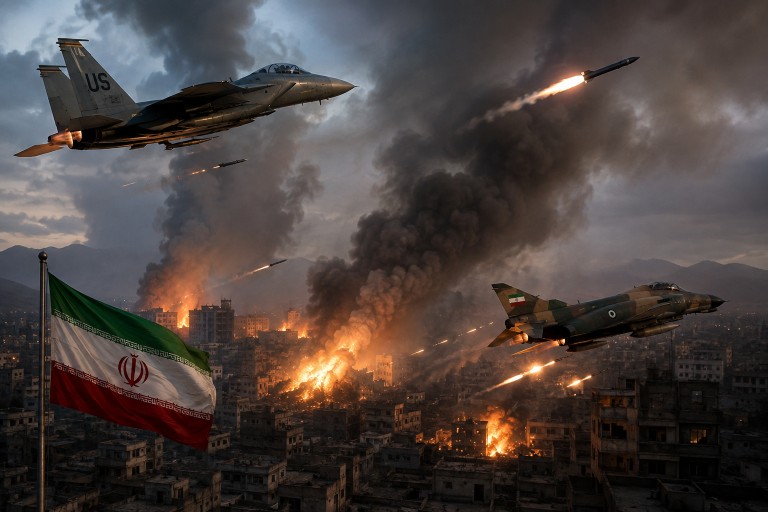
A renewed cycle of airstrikes between the United States and Iran has sparked fears of escalating conflict across the Middle East. The U.S. military launched strikes on sites associated with Iran’s Islamic Revolutionary Guard Corps (IRGC), citing these actions as retaliation for attempted attacks on commercial vessels in the Strait of Hormuz and threats against American forces.
In response, Iran unleashed missile and drone strikes targeting U.S. interests in various countries, including Jordan, Bahrain, Kuwait, and Iraq. Jordan’s forces intercepted 10 ballistic missiles, although three others landed in remote regions without causing casualties or damage to a U.S. military training site. Additionally, Iran claimed to have attacked a U.S. installation near Erbil in Iraq, while military activity was also noted in Kuwait, and air-raid warnings went off in Bahrain.
The security of the Strait of Hormuz, a vital artery for global oil trade, has been further jeopardized by these developments. The recent uptick in hostilities has already driven oil prices higher, with Iran cautioning it might obstruct Gulf oil exports if the U.S. escalates military or economic actions against it. Iranian leaders criticized the American strikes, with President Masoud Pezeshkian indicating that Tehran stands ready to respond should Washington not adhere to previous agreements aimed at de-escalating the situation.
Both nations have issued stern warnings about the consequences of further aggression, with U.S. President Donald Trump threatening a more robust response to any additional Iranian attacks. Iranian officials, on their part, have stated they will employ both military and diplomatic strategies to protect their interests. This latest flare-up follows a period where direct military engagements had been largely supplanted by sanctions and economic pressure, raising concerns that the fragile peace could unravel into sustained military conflict in the region.