
Modern medicine offers countless sophisticated diagnostic tools, yet one of the most revealing health assessments requires only your hands and a moment of honest self-examination. Gastroenterology experts emphasize that understanding your abdominal fat texture provides critical insights into metabolic health status that conventional weight measurements completely miss.
The technique is straightforward. Press your palms against your stomach area and notice what you feel beneath your hands. Soft, compressible tissue that you can easily pinch and lift away from your body indicates subcutaneous fat deposits. This fat accumulates in the superficial layer between skin and muscle, functioning primarily as energy reserves and providing some thermal insulation and physical cushioning. Though carrying excess subcutaneous fat isn’t optimal, it represents a relatively low-risk form of adiposity.
When your belly protrudes but feels hard, tight, or drum-like under pressure, you’re encountering evidence of visceral fat—a completely different and far more dangerous type of adipose accumulation. This fat doesn’t gather where you can see or pinch it. Instead, it infiltrates the deep abdominal cavity, filling spaces around your liver, pancreas, intestines, and other organs. This anatomical positioning has profound metabolic implications.
Visceral adipose tissue behaves as an active endocrine organ rather than passive storage. It constantly secretes inflammatory cytokines, adipokines, and free fatty acids into portal circulation, creating a toxic metabolic environment. These substances disrupt normal insulin signaling pathways, promoting cellular insulin resistance that can progress to type 2 diabetes. The liver becomes overwhelmed with fatty acids and develops steatosis, impairing its ability to regulate metabolism and detoxify harmful substances.
Your cardiovascular system suffers severe consequences as chronic inflammation damages arterial walls, promotes cholesterol plaque formation, and raises blood pressure through multiple mechanisms. Even individuals with relatively modest total body weight can face serious health risks if visceral fat predominates. Rather than pursuing extreme dieting or excessive exercise, focus on evidence-based lifestyle optimization: restructure nutrition around whole food protein sources, establish sustainable daily movement practices, and prioritize sleep quality and duration as essential components of metabolic health.
The Belly Texture Test: How to Identify Dangerous Fat in Seconds
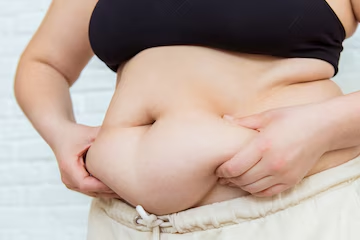
Picture Credit: www.freepik.com
126